

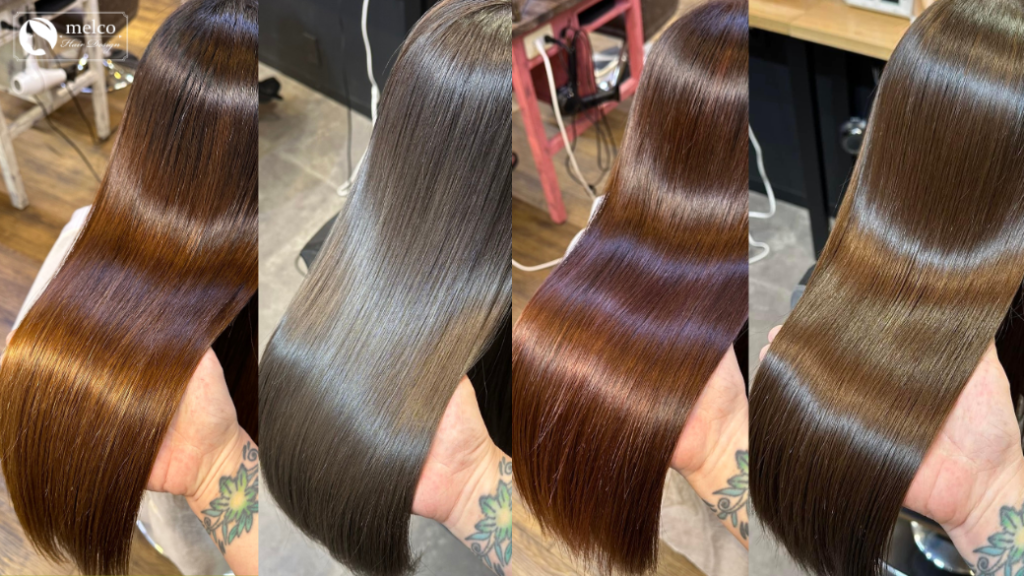
“What is the difference between Coconut Hair Straightening and regular hair straightening?”
This is one of the most common questions we receive from first-time clients at melco HairDesign BKK1 in Phnom Penh.
The simple answer is:
Coconut Hair Straightening is a type of permanent hair straightening.
However, the way we select the chemical strength, control heat, assess the hair, and think about long-term damage is different from many conventional straightening approaches.
Coconut Hair Straightening was developed for people who want to reduce curls, frizz, and unwanted volume while minimizing unnecessary stress on the hair.
If you want straighter, more manageable hair but are worried about repeated damage, stiffness, or an unnatural pin-straight finish, this article explains our approach.
Many People Are Worried About Hair Straightening Damage
If you have had permanent hair straightening before, you may have experienced concerns such as:
- “My ends became harder every time I straightened my hair.”
- “I want to control my curls, but I do not want more damage.”
- “I do not want extremely flat, pin-straight hair.”
- “My hair became more difficult to manage after repeated straightening.”
- “I am worried about losing softness and movement.”
Once you have experienced damaged or stiff hair after straightening, it is understandable to feel nervous about doing it again.
But not every hair straightening service is performed with the same products, techniques, or philosophy.
The chemical formulas used, the way the hair is assessed, the amount of heat applied, and the stylist’s technical approach can all affect the result.
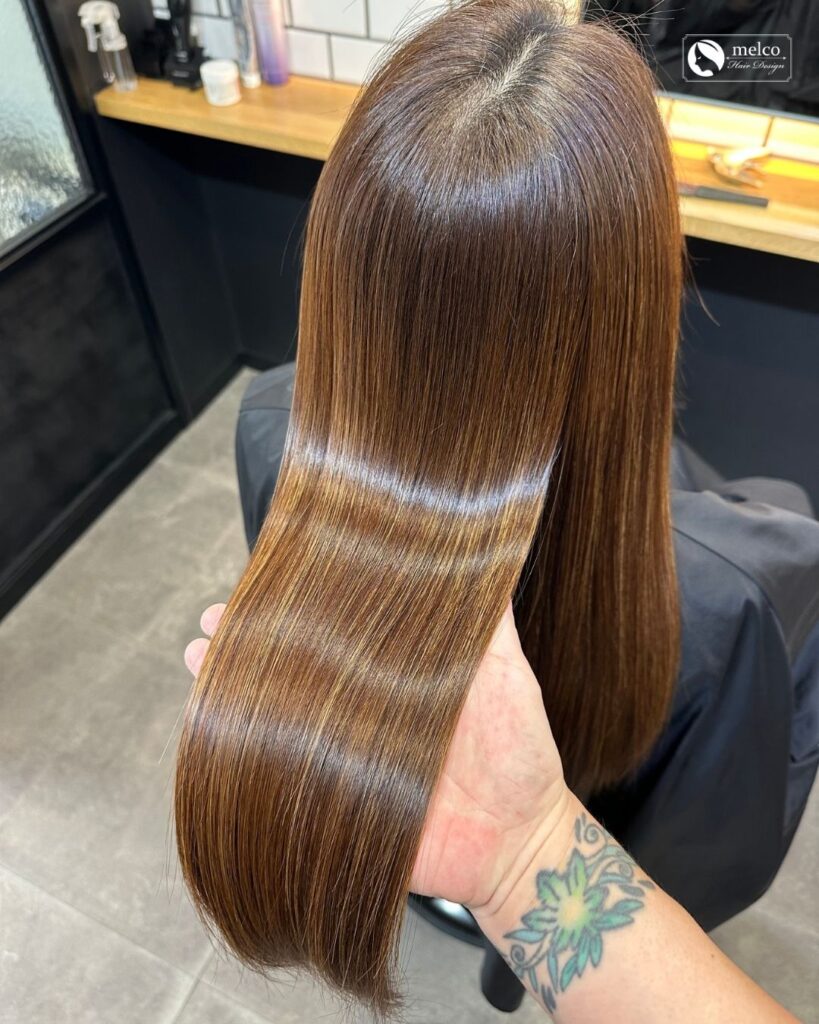
Coconut Hair Straightening Is Still Permanent Hair Straightening
Coconut Hair Straightening was developed by melco through more than 13 years of research and more than 50,000 straightening cases.
Like other permanent hair straightening services, its purpose is to reduce curls, waves, frizz, and unwanted volume so that the hair becomes easier to manage.
The difference is in how the treatment is planned.
Before beginning, we carefully consider factors such as:
- hair thickness,
- natural hair texture,
- type and strength of the curl,
- where the strongest curls are located,
- frequency of hair coloring,
- bleaching history,
- condition of the ends,
- previous straightening history,
- and the overall strength of the hair.
Based on this assessment, we follow the Coconut Hair Straightening system to control the chemical treatment and technical process consistently.
The goal is not simply to use enough strength to make the hair straight.
The goal is to use only the strength the hair actually needs.
Hair Strength and Curl Strength Are Not the Same
This is one of the most important ideas behind Coconut Hair Straightening.
A client may have very strong curls but delicate, damaged hair.
Another client may have relatively mild waves but strong, healthy hair.
If we only look at the strength of the curl, we may choose a treatment that is too aggressive for the actual condition of the hair.
That is why we consider both:
How strong is the curl?
and
How strong is the hair?
The treatment needs to balance these two factors.
This is especially important for clients who have:
- colored hair,
- bleached hair,
- highlighted hair,
- previously straightened hair,
- or damaged ends.
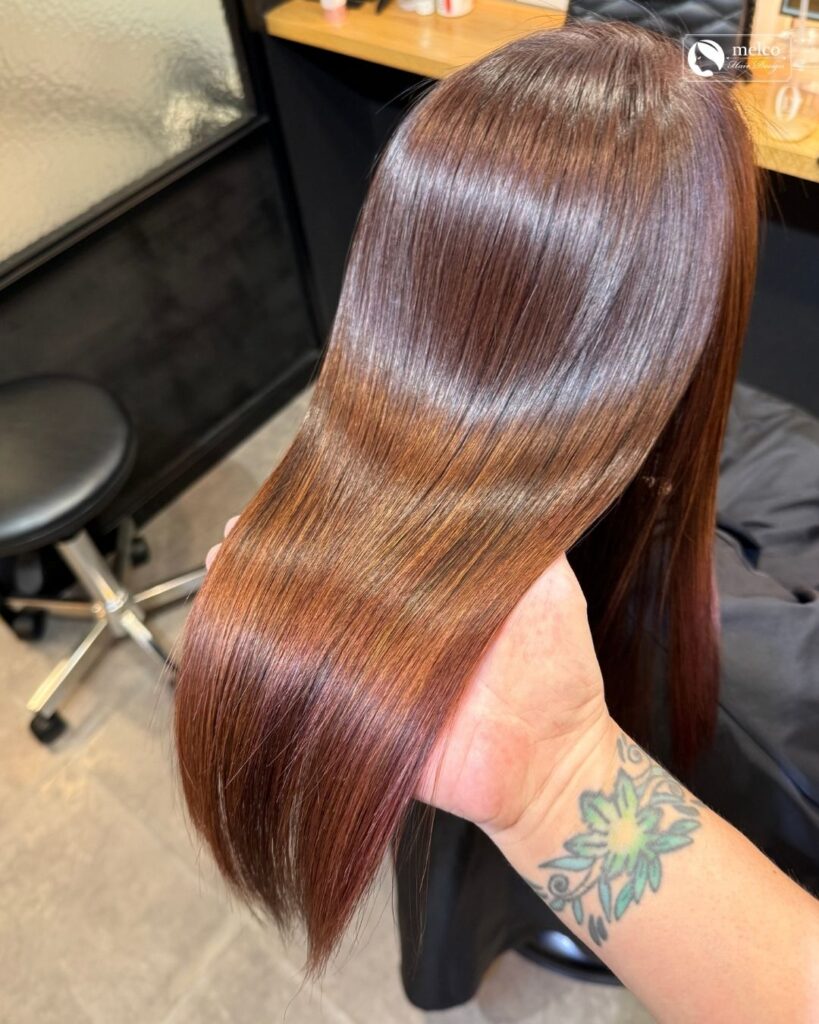
We Focus on Creating the Foundation for Your Hairstyle
Some people hesitate to get hair straightening because they imagine:
“My hair will look stiff.”
“The ends will be completely straight.”
“I will lose all movement.”
Coconut Hair Straightening is designed to preserve as much softness and natural flexibility as possible while controlling unwanted curls and frizz.
We do not see straightening as the final hairstyle.
We see it as a way to create a better foundation for hair design.
When the texture of the hair becomes smoother and easier to manage, it can become easier to enjoy:
- different haircuts,
- natural movement at the ends,
- hair color,
- long hairstyles,
- and everyday styling.
If too much chemical or heat stress is applied during straightening, the hair may become stiff and future styling options can become limited.
Our goal is the opposite.
We want to create smooth, manageable hair that gives you more freedom to enjoy your hairstyle.
Natural Straight Hair, Not an Artificial Pin-Straight Finish
One of the characteristics our clients appreciate about Coconut Hair Straightening is the natural finish.
The goal is not to create hair that looks obviously chemically straightened.
We aim for hair that:
feels soft,
moves naturally,
has a smooth surface,
looks naturally shiny,
and is easy to manage after drying.
When the curls and twists within the hair are carefully aligned, the surface becomes smoother and reflects light more evenly.
This creates natural shine without relying only on heavy oils or coating products.
Sometimes We Do Not Try to Straighten Everything in One Appointment
Coconut Hair Straightening is not a technique where we force every type of hair into a perfectly straight result regardless of its condition.
If the hair is heavily bleached, severely damaged, or weakened at the ends, we may decide not to straighten every section completely in one appointment.
The first question is always:
How much treatment can the hair safely handle right now?
If the hair cannot tolerate enough chemical or heat strength to fully straighten a certain area, protecting the hair may be more important than forcing the curl straight.
This is particularly important for clients with complicated chemical histories.
Sometimes we may recommend:
- treating only the new growth,
- using a gentler approach on damaged areas,
- leaving certain sections untreated,
- postponing straightening,
- or focusing first on a service such as MELCOCO Special Treatment.
Doing less can sometimes be the better decision for the future of the hair.
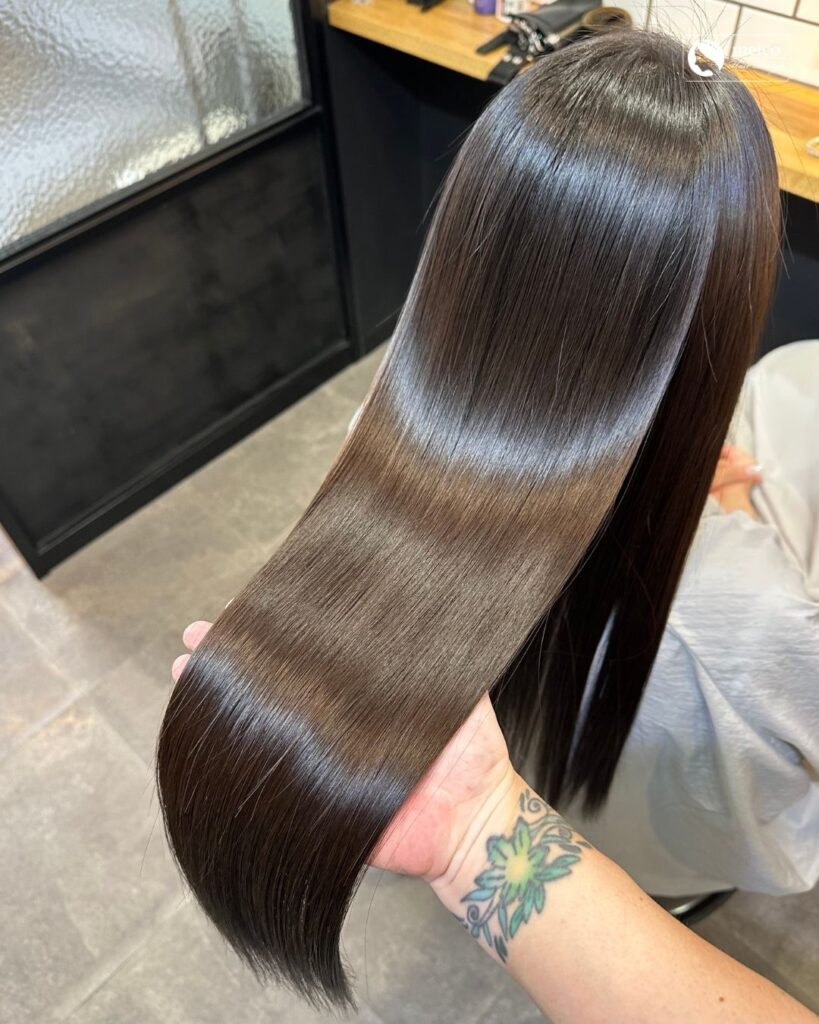
Why Repeated Hair Straightening Needs Careful Planning
Permanent straightening is not usually a one-time treatment.
Your previously straightened hair remains straight, but your natural texture continues growing from the roots.
After several months, you may want another treatment.
Over many years, this means different sections of your hair can have very different histories.
For example:
The roots may be completely untreated.
The middle may have been straightened once.
The ends may have been straightened several times and also contain hair color or bleach.
These areas should not automatically receive the same chemical treatment.
Repeatedly treating already-straightened hair with unnecessary strength can gradually lead to:
- dryness,
- stiffness,
- roughness,
- breakage,
- and loss of flexibility.
Coconut Hair Straightening is designed around the idea of reducing this unnecessary accumulation of stress.
Hair Straightening Should Be Considered Over Years, Not Just One Day
A beautiful result immediately after the appointment is important.
But for clients who regularly straighten their hair, we also think about:
three months later,
six months later,
one year later,
and several years later.
At melco, we have clients who have continued Coconut Hair Straightening for more than ten years while maintaining soft, smooth, long hair.
Our goal is to help clients continue straightening without feeling that every appointment makes their hair progressively harder or more damaged.
Permanent hair straightening is still a chemical service, so it is not completely without impact.
That is why controlling unnecessary stress during every appointment matters.
Hair Straightening in Phnom Penh’s Humid Climate
Living in Cambodia can make curly and frizzy hair especially challenging.
Phnom Penh’s heat and humidity can cause hair to:
- become frizzy,
- expand,
- develop waves,
- lose its shape,
- and become difficult to control during the day.
Many clients use a flat iron every morning just to keep their hair manageable.
Coconut Hair Straightening can help create a smoother foundation so that everyday styling becomes easier.
For many clients, simply drying the hair properly is enough to achieve a much smoother result.
This can reduce the amount of time spent fighting humidity and repeatedly using a flat iron at home.
What If You Have Colored or Bleached Hair?
Colored or bleached hair requires additional care.
We do not decide whether straightening is possible simply based on whether the hair has been bleached.
We look at the actual condition.
We assess:
- how many times it has been bleached,
- where the bleach is located,
- previous color history,
- previous straightening,
- hair elasticity,
- dryness,
- breakage,
- and the condition of the ends.
Some chemically treated hair may still be suitable for carefully controlled Coconut Hair Straightening.
Other hair may be too fragile and require another plan.
We will never recommend forcing a treatment simply because you want the hair straight immediately.
What Makes Coconut Hair Straightening Different?
The biggest difference is not simply one special chemical product.
It is the entire system.
Coconut Hair Straightening combines:
- careful hair diagnosis,
- chemical selection based on hair condition,
- control of processing time,
- controlled drying,
- precise heat management,
- ironing technique,
- and standardized technical procedures.
Every step has a purpose.
We do not want the result to depend entirely on intuition.
The treatment system has been developed so that our team can follow consistent standards and provide a high level of quality.
For People Who Want to Keep Straightening Their Hair
Coconut Hair Straightening may be suitable for you if:
- you regularly straighten your hair,
- repeated straightening has made your ends feel hard,
- you are worried about future damage,
- you have strong curls or frizz,
- you want to reduce daily flat ironing,
- you prefer a soft, natural straight finish,
- you color your hair,
- you have a complicated chemical history,
- or you want to continue enjoying different hairstyles in the future.
The purpose is not simply:
“Make the hair straight.”
The purpose is to make the hair easier to manage while preserving as many future hairstyle options as possible.
Worried About Getting Hair Straightening Again?
If you have had a previous experience where straightening made your hair feel:
dry,
hard,
rough,
unnaturally straight,
or more difficult to manage,
you may be hesitant to try it again.
The first step is to understand the condition of your hair now.
At melco HairDesign BKK1, we will carefully check your hair history and current condition before recommending a treatment.
If straightening is appropriate, we will adjust the process to your hair.
If we believe another approach is safer, we will explain that too.
Looking for Low-Damage Hair Straightening in Phnom Penh?
If you are searching for:
Japanese hair straightening in Phnom Penh,
low-damage hair straightening in Cambodia,
hair straightening for frizzy or curly hair,
a Japanese hair salon in BKK1,
or a natural alternative to stiff, pin-straight hair,
please feel free to consult with melco HairDesign BKK1.
Coconut Hair Straightening is designed not only for the way your hair looks when you leave the salon.
We think about how easy your hair will be to manage tomorrow, in several months, and over the years you continue straightening it.
Smooth.
Soft.
Naturally manageable.
And ready for the hairstyle you want to enjoy next.
melco HairDesign BKK1
Japanese Hair Salon in Phnom Penh, Cambodia
📍 No.40, Street 306, BKK1, Phnom Penh
🕘 Open 9:00 AM – 7:00 PM
🇯🇵 Japanese Stylist Available
Our Services
- Coconut Hair Straightening
- MELCOCO Special Treatment
- Japanese Hair Coloring
- Haircuts
- Hair Care for Curly, Frizzy, Colored, Bleached and Damaged Hair
If you are worried about damage from repeated hair straightening, please contact our team.
We will carefully assess your current hair condition and recommend the most suitable approach for your hair.