

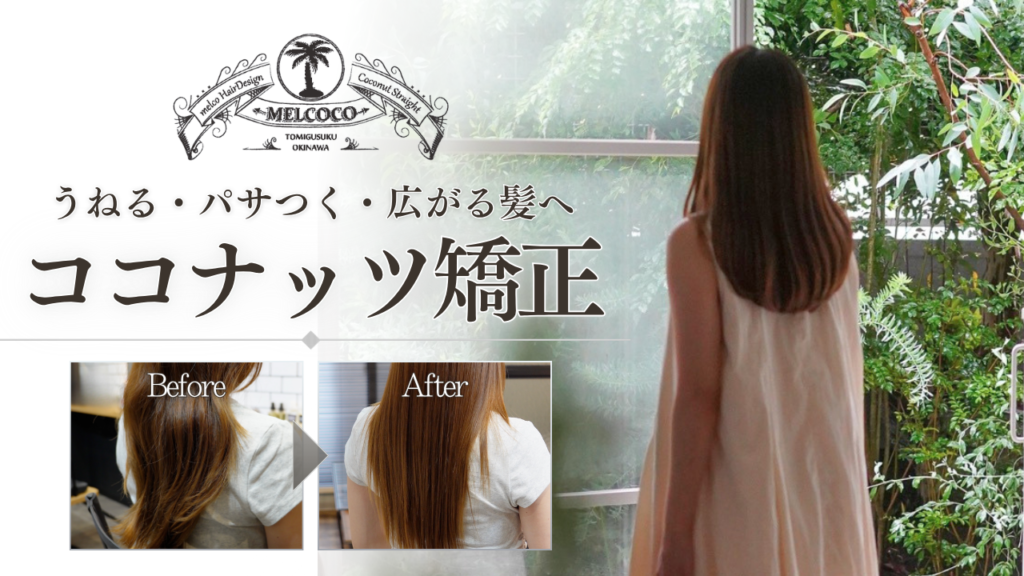
A new YouTube video featuring a full Coconut Hair Straightening® treatment by Yutaro Shimizu, founder of melco HairDesign and developer of Coconut Hair Straightening®, is now available.
Our client came to us with several concerns:
- “My hair gets wavy and frizzy.”
- “I have to straighten my hair before curling it, so styling takes a long time every morning.”
- “I’m also worried about the damage caused by using a flat iron every day.”
Whenever she wanted to curl her hair, she first had to straighten out the waves with a flat iron and then use a curling iron afterward.
Her morning styling routine could take around 30 minutes.
In this video, Yutaro carefully evaluates her hair condition and explains how he approaches Coconut Hair Straightening—from the initial consultation and hair diagnosis to the treatment process and final result.
Frizz and Dryness Are Not Always Caused by Damage
Our client colors her entire hair every two to three months, and the ends showed some dryness and reduced elasticity.
However, hair damage was not the only reason her hair looked frizzy and difficult to manage.
In her case, each strand had subtle twists and irregularities.
When the surface of the hair is uneven, light reflects in different directions instead of evenly across the hair. This can make the hair look dull, dry, or lacking in shine.
If your hair quickly becomes frizzy again even after using treatments or hair oils, the problem may not be damage alone.
The natural shape, wave, or twisting of the hair itself may also be contributing to the problem.
During the video, Yutaro examines the client’s hair by sight and touch while explaining:
- Which areas of the hair are damaged
- Whether the frizz is mainly caused by damage or natural texture
- How much chemical strength and heat the hair actually needs
- How often straightening maintenance may be recommended
Every step is determined according to the individual condition of the hair.
Coconut Hair Straightening Adjusts Chemicals and Heat to Each Hair Condition
Hair straightening works by temporarily loosening some of the internal bonds in the hair, reshaping the hair into a straighter form with heat, and then fixing the new shape in place.
But stronger chemicals and higher temperatures do not automatically create a better result.
The key is to carefully evaluate factors such as:
- Hair thickness
- Strength of the natural curl or wave
- Previous color treatments
- Damage through the mid-lengths and ends
Based on these factors, we adjust the chemical strength and the amount of heat required for each section of the hair.
During this treatment, the timing and heat application were carefully controlled to match the client’s hair texture and curl strength.
Our goal is to straighten the areas that need correction while avoiding unnecessary stress on already fragile sections.
Rather than creating hair that looks overly flat, stiff, or unnaturally straight, Coconut Hair Straightening aims to preserve the hair’s natural softness and movement.
Improving the Hair’s Foundation with Recrystallization Treatment
For this client, we also combined Coconut Hair Straightening with MELCOCO Recrystallization Treatment.
Recrystallization Treatment is designed to form water-insoluble crystalline material inside the hair, creating a more hydrophobic foundation similar to the condition of healthy hair.
Damaged hair tends to absorb water more easily, which can make it take longer to dry.
Hair with strong waves, twists, or irregular texture may also hold moisture between the uneven sections of the hair, making it feel slower to dry than naturally straight hair.
By smoothing the twists and irregularities with Coconut Hair Straightening and improving the internal foundation of the hair with Recrystallization Treatment, the hair becomes easier to dry and easier to manage.
Straight and Smooth—Before Using a Finishing Iron
After the treatment, we simply dried the client’s hair with a blow-dryer.
Before any finishing flat iron was used, she was already surprised by the result.
She commented:
“Is it really this straight just from blow-drying?”
“It’s so smooth.”
“It feels completely dry, but still slightly moisturized.”
“I just want to keep touching it.”
Even with simple hand-drying, the waves and frizz had settled, revealing a smooth and naturally glossy finish.
Because the roots were not pressed unnaturally flat, the hair still retained its natural volume and elasticity.
The bangs also remained soft and flexible rather than becoming stiff or overly straight.
Making a 30-Minute Morning Routine Much Simpler
Before the treatment, our client had to straighten her entire hair before she could curl the ends.
After Coconut Hair Straightening, she can now style her hair without first having to straighten out all of the waves and frizz.
For example, she can simply curl the ends when she wants a styled look.
Reducing the amount of time spent blow-drying and flat-ironing can make everyday hair care much easier.
Coconut Hair Straightening is not simply a technique for making hair straight.
By reducing the time and effort required for daily styling, it can also help create a little more space in your morning routine.
Watch the Full Treatment—from Consultation to Final Result
In the full YouTube video, we show not only the finished hairstyle, but the complete process, including:
- The client’s original hair concerns
- Yutaro’s evaluation of her hair texture and damage
- Why naturally textured hair can appear frizzy
- The Coconut Hair Straightening treatment process
- How chemical strength and ironing heat are controlled
- How MELCOCO Recrystallization Treatment works
- The real result immediately after blow-drying
- The client’s honest reaction after the treatment
This video is especially recommended if you are thinking:
“I want hair straightening, but I’m worried about damage.”
“My hair becomes frizzy again soon after treatments.”
“I’m tired of using a flat iron every morning.”
“I want straight hair that still looks soft and natural.”
Silky, smooth, yet moisturized.
At MELCOCO, we call this signature texture “Sara-shito”—a combination of sara-sara (silky and smooth) and shittori (soft and moisturized).
Watch Coconut Hair Straightening® developer Yutaro Shimizu perform the complete treatment, from consultation to final result, on YouTube.
▼ Watch the full video on YouTube