

Hello from melco HairDesign!
Recently, we held an on-site Coconut Hair Straightening® seminar at a hair salon in Urawa, Saitama. The seminar was led by Yutaro Shimizu, founder and representative of melco.
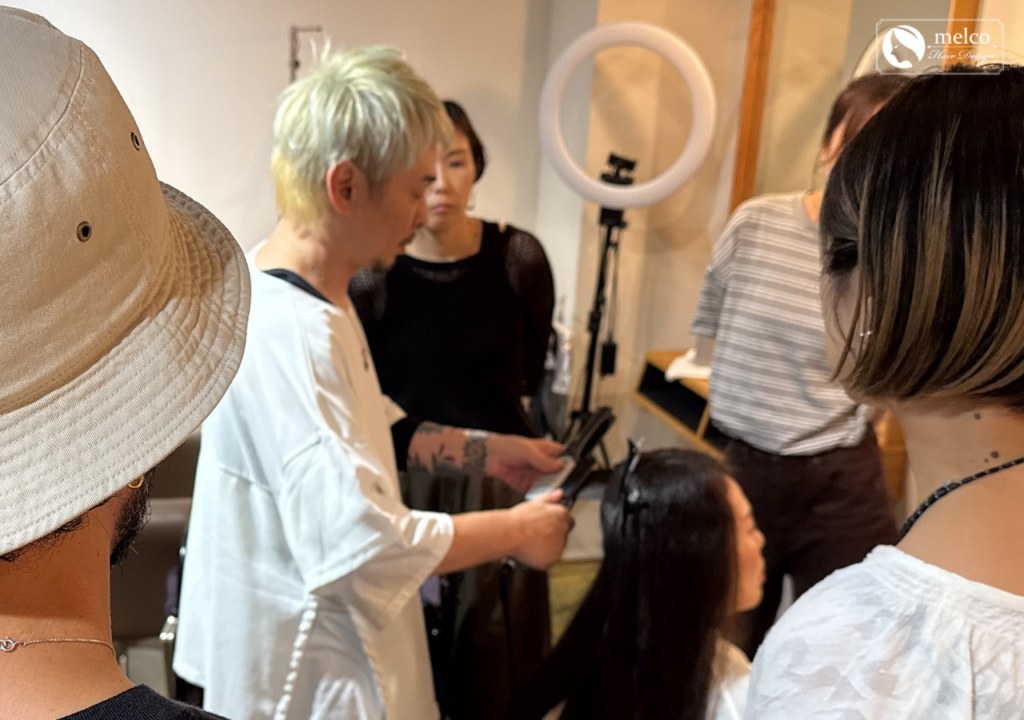
This seminar came to us through an introduction from a hairstylist who had attended one of our previous classes. Thank you very much for connecting us.
melco began teaching hair straightening techniques in 2015, and this year marks our 11th year of educational activities.
We are not only a salon that performs Coconut Hair Straightening® on real clients every day. We are also the salon where the technique, products, and theories behind it are continuously researched, tested, and developed.
Through our seminars, we share the techniques and knowledge we have built through years of salon work with hairstylists and salons throughout Japan.
Our goal is to contribute, even in a small way, to improving the standard of professional hair straightening.
In this article, we would like to share some of the principles we value most as the salon that developed Coconut Hair Straightening®.
Hair Straightening Is Not a One-Time Treatment
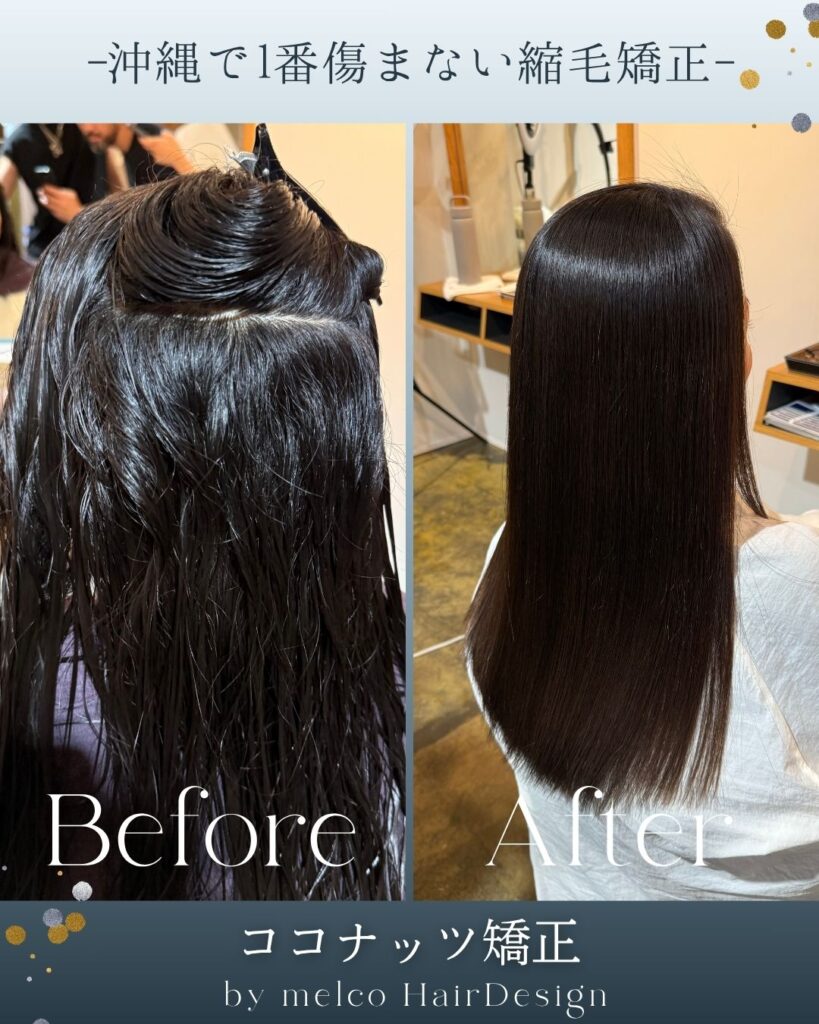
For people with naturally curly, wavy, or frizzy hair, straightening is rarely something you do only once.
Even after the hair has been beautifully straightened, new natural texture continues to grow from the roots.
That means many clients continue having their hair straightened every three months, six months, or once a year, depending on their hair type and lifestyle.
At both our Okinawa and Omotesando salons, we often hear concerns such as:
“I’ve had my hair straightened many times, and I’m worried about damage at the ends.”
“My roots are very curly, but the ends have already been straightened several times, so I don’t want to damage them further.”
“I want to continue coloring or covering gray hair while also having my hair straightened.”
This is exactly why we do not think only about how beautiful the hair looks on the day of the appointment.
We design our straightening technique with the assumption that our clients may continue straightening their hair for many years to come.
Today’s Hair Is More Complex Than Ever
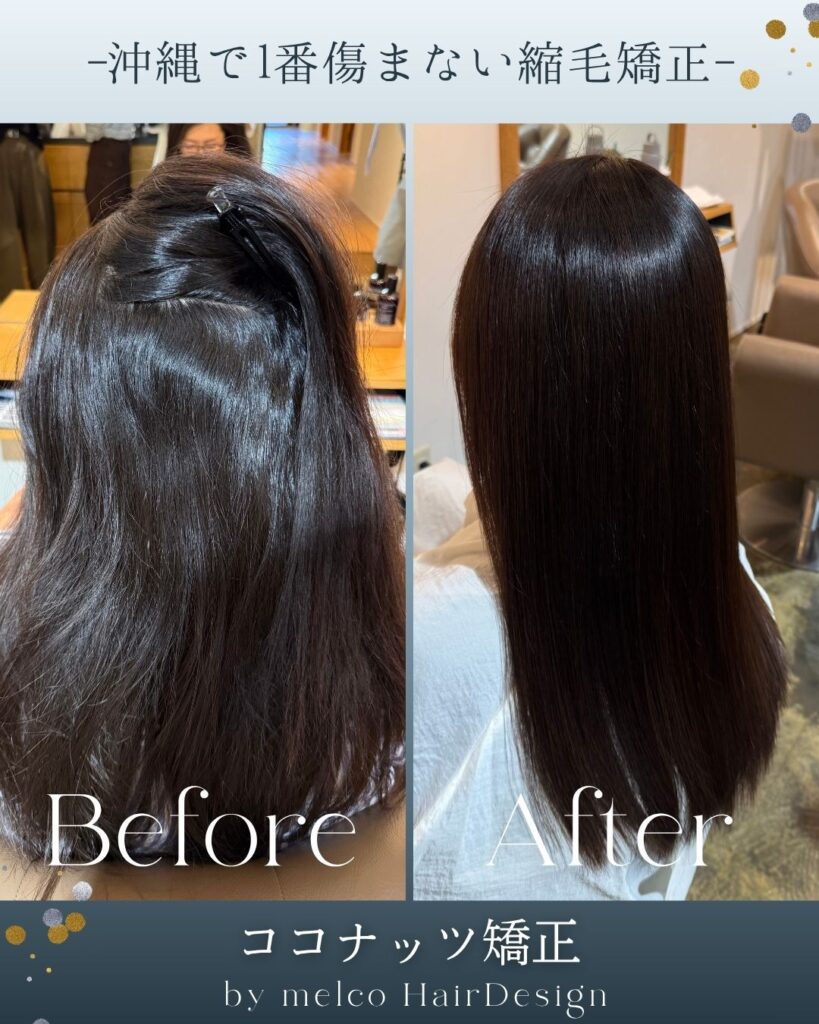
Hair color, gray coverage, bleach, highlights, perms, previous straightening treatments, and home coloring.
On top of that, there are now many different treatments marketed under names such as “hair quality improvement,” “special straightening,” or other types of smoothing services.
As a result, it can be increasingly difficult to know exactly what products and chemical processes a client’s hair has experienced in the past.
Even on a single strand of hair, the condition can vary significantly from one section to another.
The roots may be healthy, newly grown hair.
The mid-lengths may have been colored several times.
And the ends may still contain the effects of previous straightening, bleaching, or other chemical services.
Although these sections may look similar from the outside, the amount of strength remaining in the hair—and how much chemical or heat exposure it can safely tolerate—can be very different.
Strong new growth may require enough strength to properly straighten the natural texture.
At the same time, previously straightened ends or areas weakened by repeated coloring or bleaching should not be exposed to more stress than necessary.
Accurately assessing the condition of the hair and precisely controlling both chemical processing and heat is essential.
If the treatment is too weak, the curl remains.
If it is too strong, the hair becomes damaged.
That is why hair straightening cannot rely on instinct alone.
It requires a clear technical theory.
For clients with naturally curly or wavy hair, new textured hair will continue growing from the roots.
Straightening may therefore be repeated for years—or even decades.
If unnecessary stress is added every time, the ends gradually become weaker.
Eventually, the hair can reach a point where it can no longer tolerate further treatment and has to be cut.
This is why Coconut Hair Straightening® is designed to straighten the hair while preserving as much of its remaining strength as possible.
We avoid unnecessary chemical stress.
We avoid unnecessary heat.
By minimizing cumulative deterioration, we aim to create hair that continues to feel soft and healthy while remaining suitable for repeated straightening treatments.
This idea of long-term sustainability has always been one of the most important principles behind Coconut Hair Straightening®.
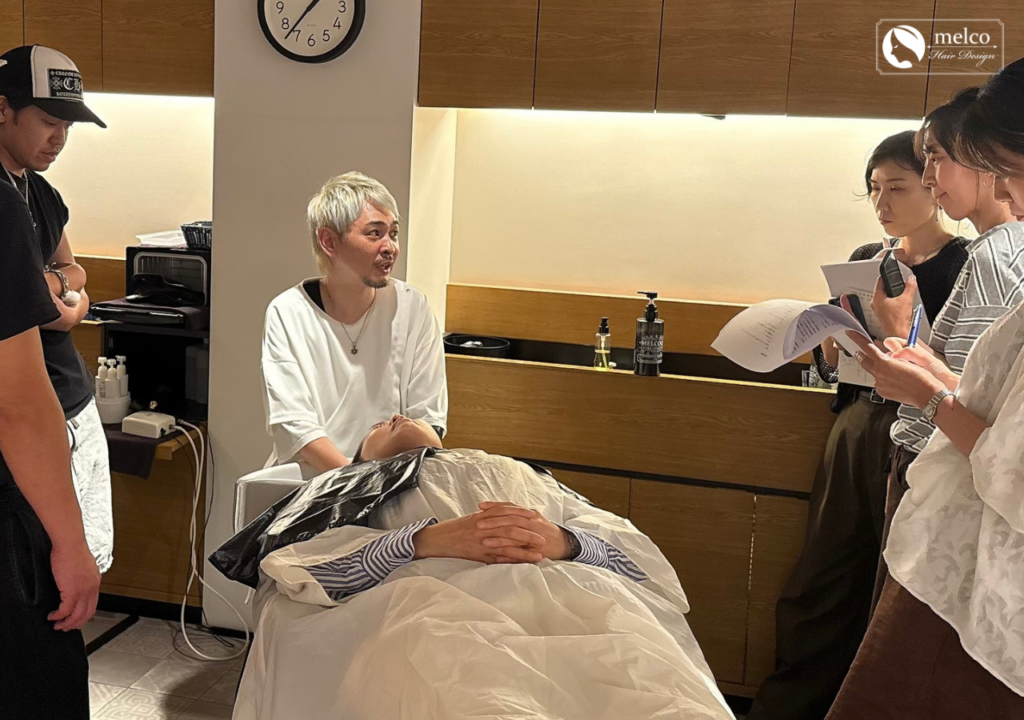
Coconut Hair Straightening® Was Developed Through More Than 15 Years of GMT Research
At melco, we have studied and worked with a reducing agent called GMT for more than 15 years.
One of the most difficult parts of professional hair straightening is not simply choosing a particular product or knowing the names of chemical ingredients.
What truly matters is being able to assess the condition of the hair in front of you and accurately control the entire straightening process through chemistry and heat.
This includes reduction, reshaping, and oxidation.
The hairstylist needs to understand what is happening inside the hair and make the appropriate decisions at every stage.
Another principle we have taught consistently for more than 10 years is this:
Do not make the treatment unnecessarily complicated.
The core Coconut Hair Straightening® system is built around only three main chemical formulations.
Rather than thinking:
“This is bleached hair, so we need a completely different product.”
“This is aging hair, so we need another treatment agent.”
“The reaction is not strong enough, so let’s add another chemical.”
—we believe it is more important to understand the fundamentals:
Why does curly hair become straight?
Why does hair become damaged?
Once those principles are understood, the hairstylist can adjust the strength of the chemicals and the technique according to the actual condition of the hair.
With that approach, even challenging cases such as strong curls, fine hair, aging hair, color-treated hair, and hair with a history of bleaching can be approached through a relatively simple and consistent system.
To improve both consistency and reproducibility, melco has also developed our own product-selection application and flat-iron timing system based on the logic of Coconut Hair Straightening®.
Rather than relying solely on the stylist’s intuition, we aim to create clearer standards for each stage of the process—from selecting the appropriate chemical strength to controlling the amount of heat applied with the straightening iron.
The goal is simple:
Do not use more chemical strength than necessary.
Do not apply more heat than necessary.
Use exactly the amount of strength required to straighten that particular hair type while preserving as much elasticity and softness as possible.
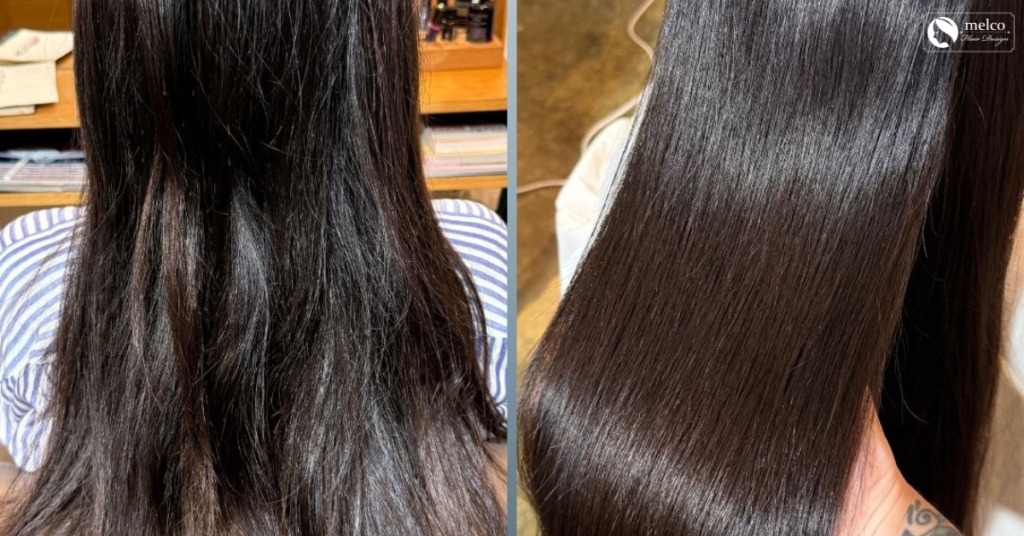
The result is hair that feels silky, yet moisturized.
Smooth, but never stiff.
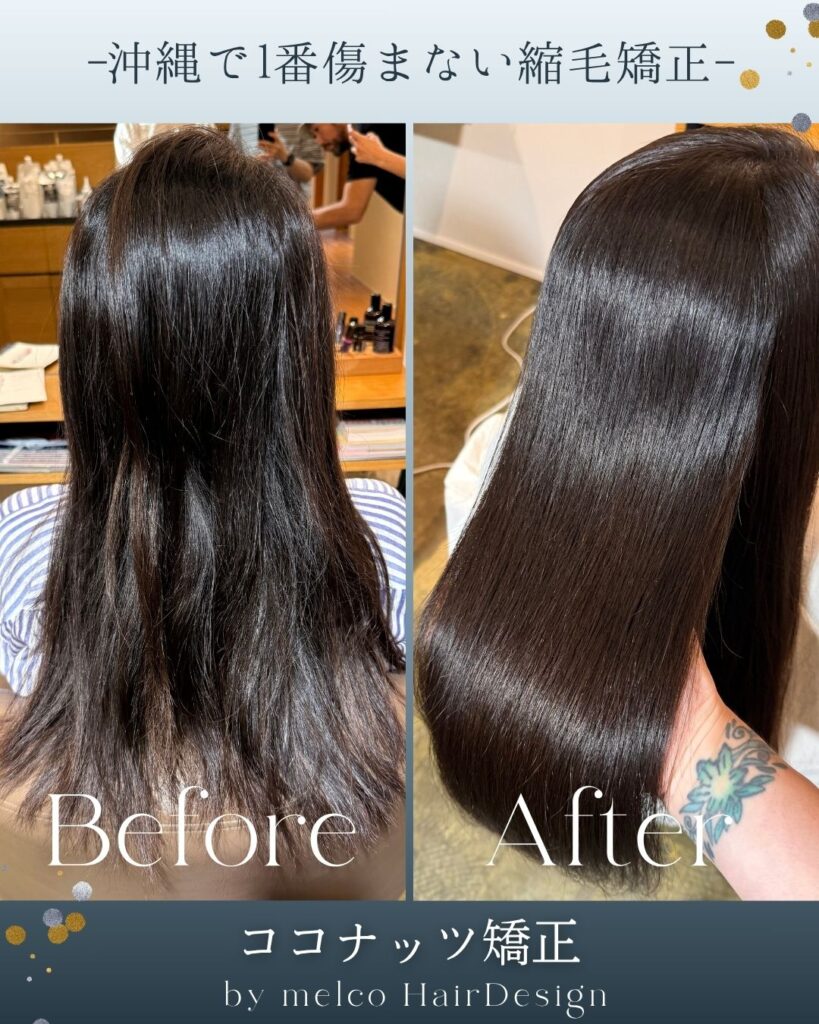
This is the unique texture we describe in Japanese as “Sarashito”—a combination of silky smoothness and soft, hydrated movement that defines Coconut Hair Straightening®.
And what matters most is not only how the hair feels immediately after the salon appointment.
We want clients to wash and dry their hair at home the next day and still think:
“My hair is so easy to manage.”
We want that feeling to continue for weeks and months after the treatment.
Because hair straightening is something many clients repeat for years, we believe that considering the long-term condition and manageability of the hair is essential to building a technique clients can continue to trust.
melco HairDesign is the development salon behind Coconut Hair Straightening®.
Every day, we work directly with our clients’ hair in the salon.
We test the techniques we have developed in real salon situations, learn from those results, and use that experience to continue improving our products and methods.
We then share the knowledge and techniques developed through our salon work with hairstylists throughout Japan through our professional education programs.
Our recent seminar in Urawa, Saitama was one part of that ongoing work.
We hope the hair straightening philosophy and techniques developed at melco will continue to reach more hairstylists, more salons, and ultimately more people who struggle with curly, wavy, frizzy, or difficult-to-manage hair.
Looking for Hair Straightening at melco HairDesign?
At melco HairDesign, with salons in Okinawa, Tokyo, and Phnom Penh, Cambodia, we carefully assess each client’s hair type, condition, and treatment history before recommending the most suitable approach.
Whether you are concerned about strong curls, waves, frizz, dryness, volume, or damage from previous color, bleach, or straightening treatments, our goal is to straighten your hair while minimizing unnecessary stress and preserving as much softness and strength as possible.
You are always welcome to contact us if you are wondering:
- Can my hair be straightened safely?
- I have previously bleached or colored my hair. Can I still have hair straightening?
- My hair has been straightened many times. Is it still possible to treat it safely?
- I’m not sure which treatment or menu is right for my hair.
Our team will be happy to discuss your hair history, current condition, and desired result before your appointment.
Coconut Hair Straightening® — developed by melco HairDesign.